





Saving 12% Fuel Per Voyage! World's First Wind-Assisted LNG Carrier Unveiled
Source:CNSS
2026-05-18
The world's first LNG carrier fitted with solid wind sails is nearing completion at a South Korean shipyard. Hanwha Ocean showcased the vessel, built for MOL, marking a major breakthrough for wind-assisted propulsion technology in the LNG carrier segment.
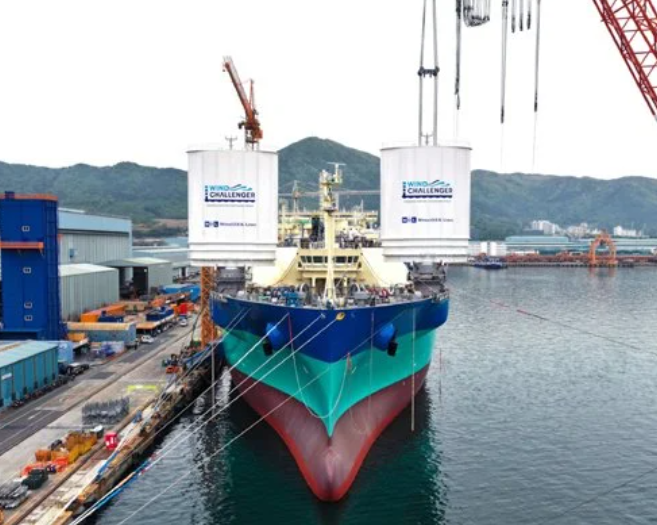
MOL previously collaborated with Japan's Oshima Shipbuilding to successfully commercialize a telescopic hard sail design made from fiber-reinforced plastic. The technology was first deployed on a coal carrier that entered service in October 2022 and has since been extended to multiple newbuilding bulk carriers, as well as retrofitted onto an existing vessel.
To extend the technology to LNG carriers, MOL partnered with Hanwha Ocean and ClassNK in 2024 to complete a comprehensive risk assessment covering sail arrangement, impact on visibility, emergency operating procedures, and other safety measures. Concurrently, MOL worked with GTT, which holds patented LNG containment technology, to evaluate the impact of the sail installation on the cargo tanks. Following this process, ClassNK issued MOL the world's first Approval in Principle (AiP) for an LNG carrier equipped with a hard sail system.
Hanwha Ocean announced it has successfully completed the world's first installation of the "Wind Challenger System" on an LNG carrier. The vessel was ordered in 2024 under an agreement between MOL and Chevron Shipping and is scheduled for delivery in 2026. Measuring approximately 286 meters in overall length, the ship will be fitted with two rigid wind sails mounted on the deck near the bow. Each sail consists of three panels and, when fully extended, rises approximately 49 meters above the deck, with each unit spanning roughly 15 meters in width.
This vessel is the first of two LNG carriers in MOL's plan to deploy wind sail technology. The second LNG carrier, with an overall length of 295 meters and a capacity of 174,000 cubic meters, will be equipped with an Everllence main engine from MAN Energy Solutions.
According to MOL's estimates, an LNG carrier equipped with two wind sails is projected to save up to 12% in fuel per voyage, depending on weather and sea conditions. With the shipping industry facing increasing pressure to reduce fuel emissions, wind-assisted propulsion technology is attracting growing attention.
Hot News