


Sallaum Lines Officially Signs with CM Shipyard for 1+1 8,600‑CEU PCTCs
Source:Beyond Shipping
2026-07-31
On July 27, car carrier operator Sallaum Lines officially announced that it had signed a shipbuilding contract with China Merchants Jinling Shipyard (Nanjing) (hereinafter referred to as “CM Shipyard”) for 1+1 8,600 CEU dual‑fuel PCTCs, with delivery scheduled for 2029.
Sallaum Lines stated that just a few weeks after placing an order for 2+2 8,600 CEU dual‑fuel PCTCs at Xiamen Shipbuilding Industry (XSI), it placed another order for 1+1 units of the same type at CM Shipyard.
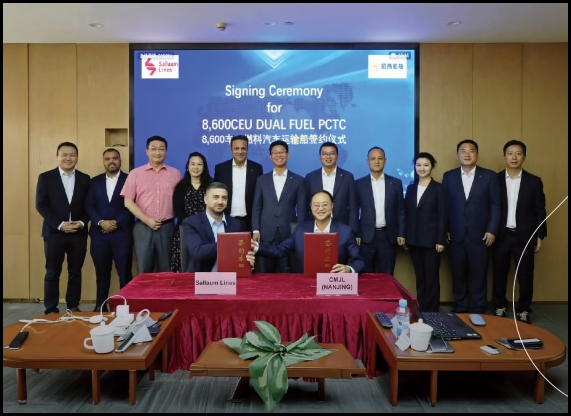
With this new order confirmed, Sallaum Lines’ newbuilding portfolio now totals nine PCTCs, with a combined value exceeding USD 850 million. Among them, four vessels have already been delivered, one is scheduled for delivery in August 2026, one in December 2026, and three in 2029.
Hasan Sallaum, Managing Director of Sallaum Lines, commented: “This new order with CM Shipyard is another important step in the future fleet development of Sallaum Lines. Just a few weeks after ordering 2+2 PCTCs at XSI, we are pleased to confirm this additional 1+1 8,600 CEU car carrier order. It demonstrates the momentum behind our fleet renewal programme and our confidence in the long‑term fundamentals of the PCTC market.”
He pointed out: “The automotive logistics market is changing. Customers need their transport partners to provide capacity, reliability, flexibility and a clear path to lower carbon emissions. With our newbuilding programme, Sallaum Lines is investing in all these areas. The LNG‑ready and ammonia‑ready design gives us a practical solution to prepare for both the present and the future.”
He emphasised: “Sallaum Lines believes that a modern fleet should be built with scale, discipline and flexibility.”
Indeed, the global PCTC fleet remains a highly specialised niche segment, with about 700 PCTCs worldwide. In recent years, the PCTC market landscape has been evolving, with strong demand emerging from multiple directions.
Traditional car exports remain the core driver, while China’s complete‑vehicle exports, electric vehicles, hybrid vehicles, construction machinery, agricultural equipment and other heavy breakbulk cargoes have further expanded the source structure of market cargo. The market demand pattern is becoming increasingly complex. It is no longer merely about moving passenger cars from manufacturing bases to another location, but increasingly involves connecting global production, emerging consumer markets, China’s export growth, heavy ro‑ro equipment transport needs, and port networks that handle a wider variety of cargoes.
The 8,600 CEU series is the largest vessel type in Sallaum Lines’ fleet and represents one of its most significant investments.
The 8,600 CEU design not only provides Sallaum Lines with scale, but also preserves the operational flexibility needed to serve a diverse range of customers and ports. These vessels are capable of carrying a wide variety of cargoes, including passenger cars, light commercial vehicles, trucks, heavy ro‑ro equipment and project cargo. The series measures 199.9 metres in length overall, 38 metres in beam, with an air draught of 46 metres and is fitted with five liftable decks. After delivery, they will be deployed on Sallaum Lines’ core automotive logistics network, covering routes across Europe, the Americas, Africa and the Middle East, further consolidating its position as a forward‑looking ro‑ro carrier and expanding its presence among fast‑growing Chinese exporters.
Sallaum Lines noted that by securing capacity for delivery in 2029 now, the company is preparing for the next phase of market development, while ensuring that its future fleet remains aligned with customer expectations and environmental regulations. This order also reflects the growing role of Chinese shipyards in the global PCTC newbuilding market.
Hot News